2400 trace
Choose 2400 IV Trace from the Keithleys catalogue for a buffered current- or voltage-source sweep using a Keithley 2400-series source-meter. Scan supplies arbitrary source points; configuration programs them as a LIST sweep. The instrument’s trigger model and buffer acquire the whole curve before results are retrieved. For measurement children at each held source level, use the 2400 point scan in Keithley point scans and set commands.
Basic settings
Settings > Basic selects the GPIB resource, current/voltage source mode, compliance, integration, delays, output-enable behaviour and source/sense ranges. In current-source mode the direct compliance limit is a voltage; in voltage-source mode it is a current. Resistance-derived compliance is also available.
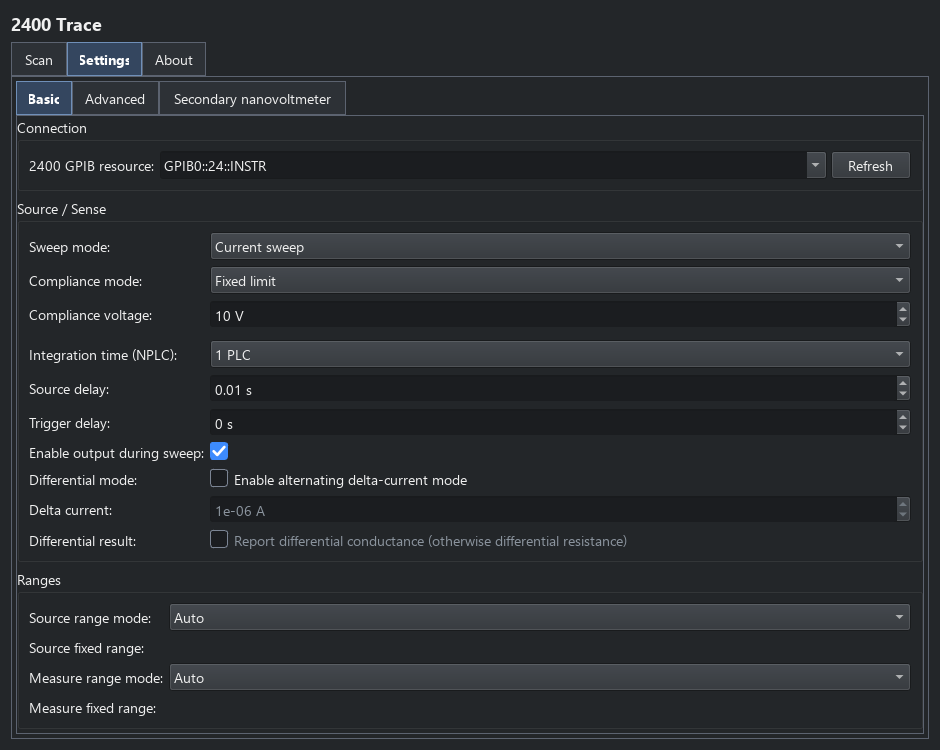
Basic settings for the buffered 2400 trace.
The default configuration uses current sourcing, fixed 10 V compliance, front terminals and four-wire remote sense. Check wiring and compliance for the connected sample before running; the screenshot is an example configuration.
Advanced settings and triggering
Advanced selects front/rear terminals, two/four-wire measurement, digital or median filtering, and immediate, bus, external, Trigger Link or timer routing. Trigger input/output lines, counts and timer intervals must match the experiment. Trigger output is enabled by default on line 2. The complete routing overview is in Keithley connections and triggering.
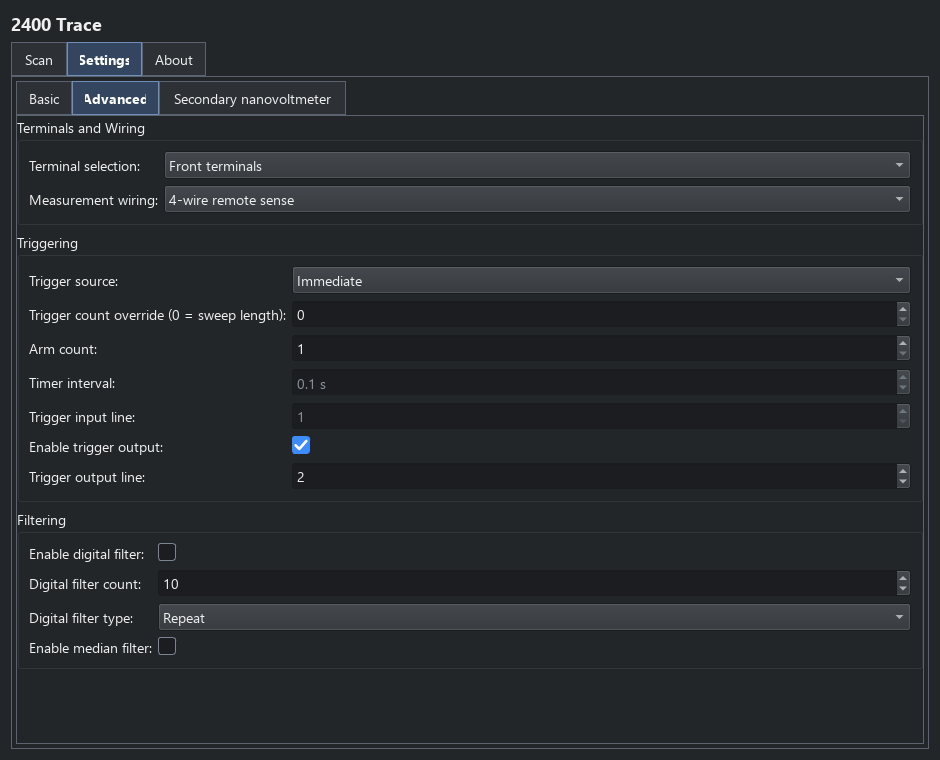
Wiring, trigger and filter settings.
Secondary nanovoltmeter optionally enables a separate GPIB-connected
Keithley 182 or 2182A, with a column prefix and supported integration, range
and filtering options. It uses a Trigger Link handshake with the SMU and adds
prefixed voltage, response and power columns to IV. Enabling it determines
the acquisition handshake; see Keithley connections and triggering rather than combining
it with an unrelated free-running trigger scheme.
Results and differential acquisition
The ordinary IV trace contains programmed source x, measured
Current (A), Voltage (V), derived Resistance (ohms), Power (W)
and Timestamp (s). The programmed source column is distinct from measured
current/voltage. Plot Trace selects the response channels; Save writes the
result table as described in Collecting, fitting and saving data.
In current-source mode, Differential mode alternates positive/negative
Delta current offsets about the nominal scan values. It requires at least
three points and a positive delta current. The returned source axis remains
nominal; reduced neighbouring readings supply voltage and differential
resistance, or Conductance in siemens when selected. Endpoint responses
use the nearest interior reduction. Power uses delta current times the reduced
voltage change. This is not the native 6221 Pulse Delta mode.
Lifecycle and Python access
Configuration prepares the list, trigger model and buffer. Each measurement starts a fresh acquisition and reads the buffered results. With the normal output-enable setting, output stays enabled until disconnect; cleanup disables output and releases the SMU and any owned secondary-meter session.
For attributes and console use, find Keithley2400SweepPlugin in the
plugin API reference.
Return to Keithley meters for the other trace modes and point commands.
