6221/2182A trace
Choose 6221/2182 IV Trace from the Keithleys catalogue for a current-driven I-V curve with a Keithley 6221 and primary 2182A nanovoltmeter. The scan generator supplies a current list in amperes; Trigger Link handshaking coordinates the source and buffered readings. This is a complete trace acquisition. Use Keithley point scans and set commands when the source must hold each DC level while child steps run.
Connections and settings
On Settings > Primary 6221 / 2182A, select the 6221 GPIB resource and choose how to reach the 2182A: through the 6221 serial relay, or through its own GPIB resource. Serial relay carries commands; Trigger Link still carries the measurement handshake.
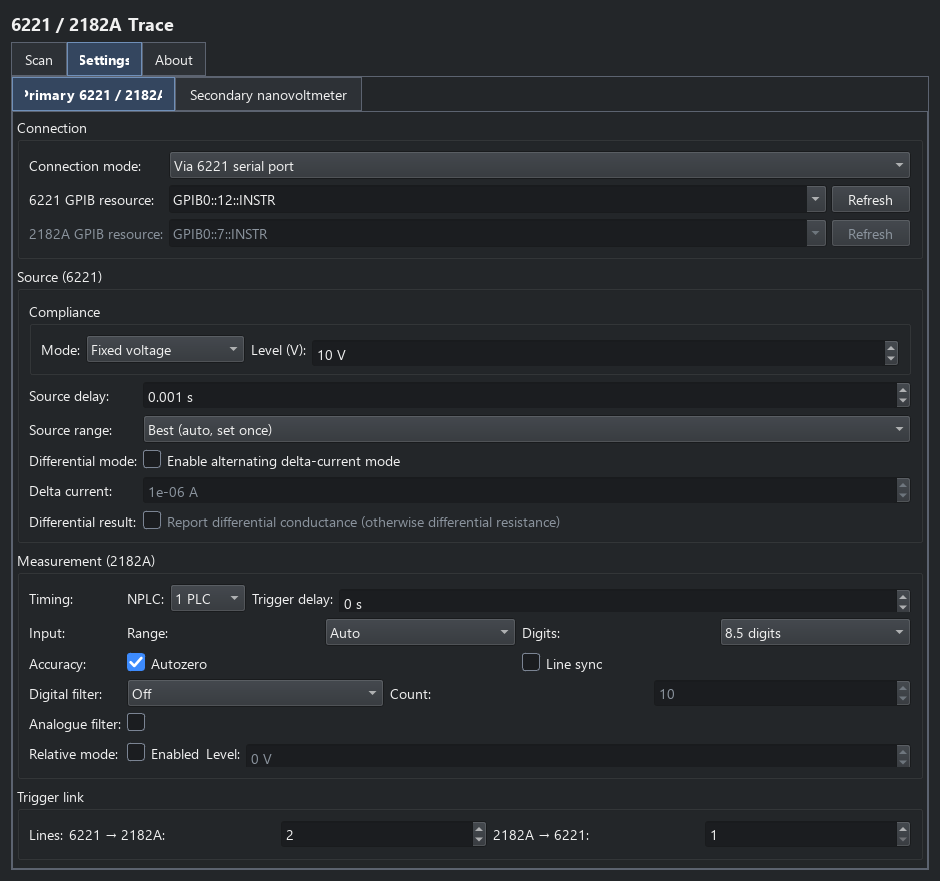
Primary source and meter configuration. The secondary meter is enabled for this illustrated configuration, but connects only when the sequence runs.
Choose fixed-voltage compliance or the per-point limit derived from
abs(current) * compliance_resistance. Configure the settling delay and
current-range policy: Best selects a range for the whole list, Auto
permits per-point range changes, and a fixed range holds the selected value.
The meter controls cover NPLC integration, voltage range, digits, trigger
delay, autozero, line synchronisation, digital/analogue filters and relative
mode. Runtime expressions are evaluated by the acquisition configuration,
not by the scan preview.
The source-to-meter and meter-to-source trigger lines must match the wiring. Defaults are line 2 from the 6221 to the 2182A and line 1 for the return handshake. See Keithley connections and triggering before changing them.
Optional second nanovoltmeter
Secondary nanovoltmeter enables an independently connected Keithley 182 or 2182A. Set its GPIB resource, column prefix, supported integration/range/ filter settings and trigger routing. Controls follow the selected driver.
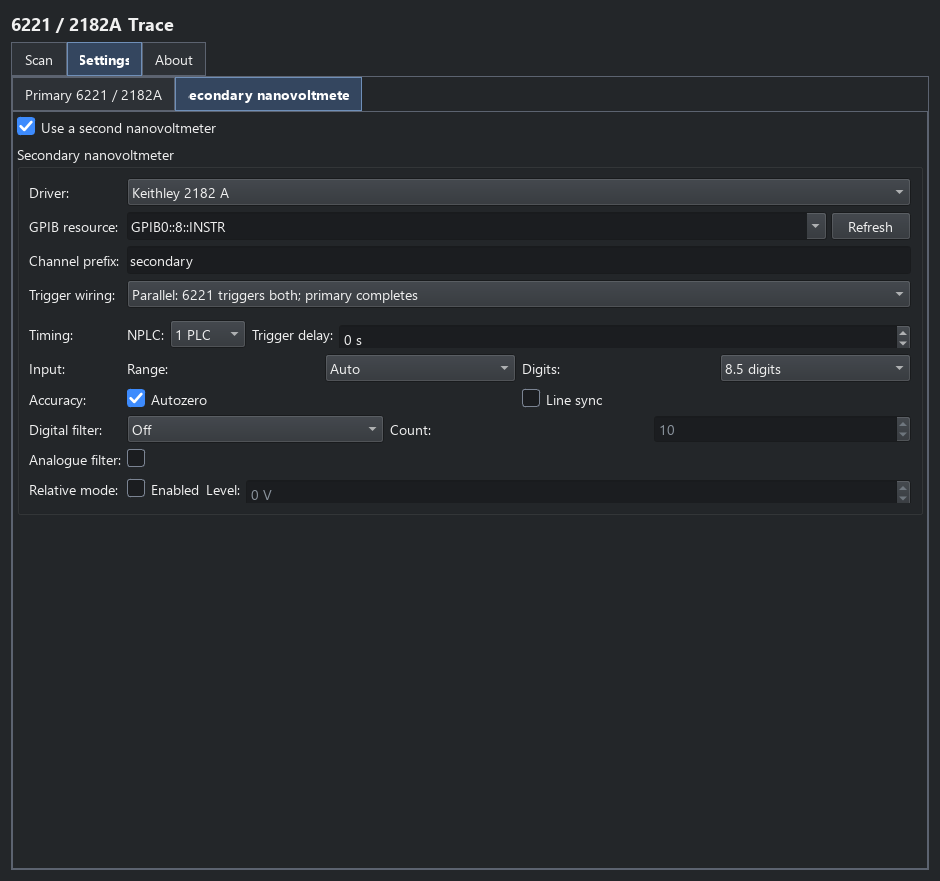
Secondary-meter configuration for the ordinary 6221/2182A trace.
In parallel routing, both meters receive each source trigger; the primary returns the handshake. The secondary must finish before the next trigger. The configuration warns when estimated integration/filter time is too long. In daisy-chain routing, the primary triggers the secondary, and the secondary’s completion advances the source. This waits for both conversions. See the routing guide for the separate trigger lines.
Scan and results
Scan selects the current generator. The IV trace has programmed current
x (A), V (V), R (ohms) and P (W). Ordinary-mode resistance is
V / I and is NaN at zero current; power is I * V. Enabling the second
meter adds prefixed voltage, response and power columns to the same table.
Plot Trace and Save consume this complete result; see Collecting, fitting and saving data.
Differential mode alternates positive and negative Delta current offsets
around the nominal scan currents. It needs at least three points and a
positive delta current. Returned x values remain nominal; neighbouring
readings supply reduced voltage and differential R or G (siemens),
depending on the resistance/conductance choice. Power uses delta current
times the reduced voltage change. Endpoint responses use the nearest interior
reduction. This is separate from 6221/2182 Pulse Delta trace.
Acquisition and cleanup
The plugin programs the current list and retrieves buffered meter readings after each sweep. It owns the source, primary-meter connection or serial relay, and any enabled secondary-meter session. Disconnect attempts to disable the source output and close those sessions. Do not use the buffered sweep as a substitute for a held-DC point scan.
For the Python API and console attributes, find Keithley6221_2182APlugin
in the plugin API reference.
Return to Keithley meters to compare the available acquisition modes.
